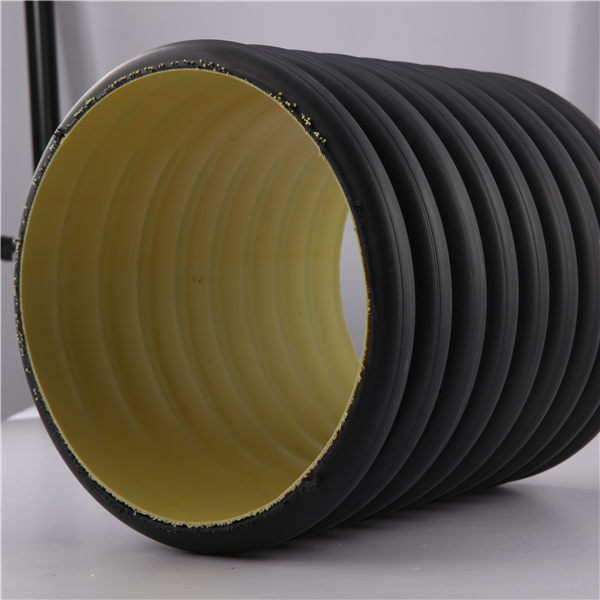
Pipe size range: Φ20 mm to Φ800 mm; standard colours are black and white. Available lengths are 4 m, 5 m, and 6 m, with custom lengths available. Manufactured to GB/T13663—2000 and connected by hot-melt welding.
Product introductions
HDPE drainage and irrigation pipes are made from HDPE resin as the main material, produced by extrusion, sizing, cooling, cutting, and other processing technologies. The pipes are tested and can be provided in compliance with the relevant standards. They are widely used in municipal and rural water supply projects and similar applications.
Characteristics
(1)HDPE pipes and fittings are hygienic and non-toxic. They prevent scale formation, inhibit algae growth, and help reduce the risk of secondary pollution during use.
(2)The working temperature of HDPE pipes is not more than 40℃. They are suitable for the transportation of general pressure water and drinking water.
(3)HDPE pipes feature attractive color and smooth inner and outer walls without concave/convex irregularities. They offer low flow resistance. The water conveyance capacity is 0.6–0.7 times that of iron pipes of the same diameter.
(4)HDPE pipes are lightweight with high strength, excellent impact resistance, and corrosion resistance. They are easy to carry and install, which significantly reduces labor intensity during construction and assembly.
(5)Thanks to their light weight, ease of jointing, and inherent toughness, HDPE pipes are convenient to install. For more complex piping systems, HDPE pipes offer greater advantages compared with pipes made from other materials. The service life can exceed 50 years, and they provide good water-tightness performance.
Technical requirements
• The pipe shall contain no visible impurities.
• The cut end of the pipe shall be flat and perpendicular to the pipe axis.
• The pipes are opaque for use in both above-ground and underground water supply systems.
• The internal and external surfaces of the pipe shall be smooth and flat, without cracks, sags, decomposition lines, or other surface defects that may affect pipe quality.
Application
1. Municipal water supply
2. Industrial liquid transportation
3. Sewer, storm & sanitary pipelines
4. Commercial & residential water supply
5. Water & wastewater treatment plants / corrosive & reclaimed water / sprinkler irrigation systems
6. Irrigation systems & drip irrigation systems