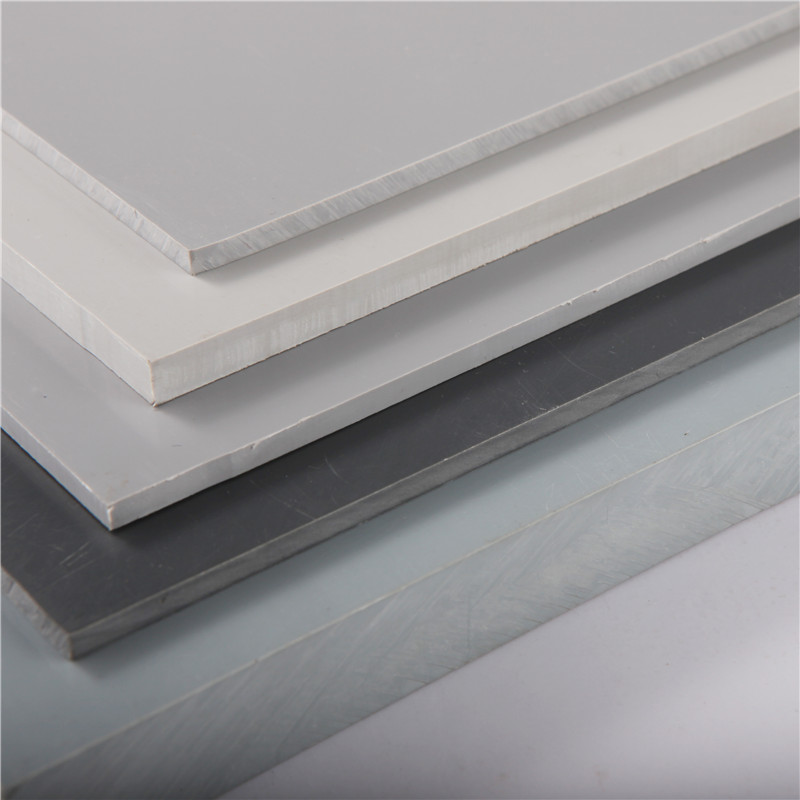
Available in dark grey and light grey, this 3–20 mm thick board is offered in widths up to 1,300 mm and any length. It is available in standard sizes of 1,000 × 2,000 mm, 1,220 × 2,440 mm, and 1,300 × 2,000 mm, making it suitable for a wide range of industrial and construction applications.
Raw material properties
Raw material name: chlorinated polyvinyl chloride (English: Chlorinated Polyvinyl Chloride), also known as chlorinated resin. Chlorinated resin is a new type of engineering plastic. After chlorination of PVC resin, the irregularity of molecular bonds, polarity, solubility, and chemical stability are improved. As a result, the material’s heat resistance and resistance to acids, alkalis, salts, and oxidizing agents against corrosion are enhanced. In addition, the mechanical properties, reflected by the numerical thermal deformation temperature, are improved. The chlorine content increases from reference: 56.7% to typical: 63–69%, and the Vicat softening temperature increases from reference: 72–82 °C to typical: 90–125 °C. Therefore, CPVC is a new type of engineering plastic with broad application prospects.
Production process and capacity
CPVC sheet is produced using chlorinated polyvinyl chloride as the raw material. After first weighing, the raw materials are fed into the mixing system. First, hot mixing and stirring are performed to reach a specified temperature, followed by cold mixing and stirring. After mixing, the compound is transferred to the feeding system and then extruded into molds. Screw extrusion molding is carried out, followed by three-roll secondary finishing to achieve a smooth surface. Finally, sheets are cut to the required sizes in accordance with the order.
Capacity
We operate 20 PVC sheet production lines with an annual production capacity of 30,000 tons, and 3 CPVC sheet production lines with an annual production capacity of 3,000 tons.
Characteristics
High Vicat softening temperature;
Excellent chemical resistance and corrosion resistance;
Excellent thermal stability performance;
Easy to fabricate, weld, or machine;
High rigidity and superior strength;
Reliable electrical insulation;
Low flammability and self-extinguishing.
Applications
CPVC sheet is mainly used in the chemical industry for chlorine electrolysis, electroplating, the paper industry, the semiconductor industry, and clean-room technology, such as laboratory equipment, etching equipment, semiconductor processing equipment, chemical storage tanks, oil tanks, brewing-water storage tanks, acid or alkali production towers, and acid or alkali washing towers, among others.